

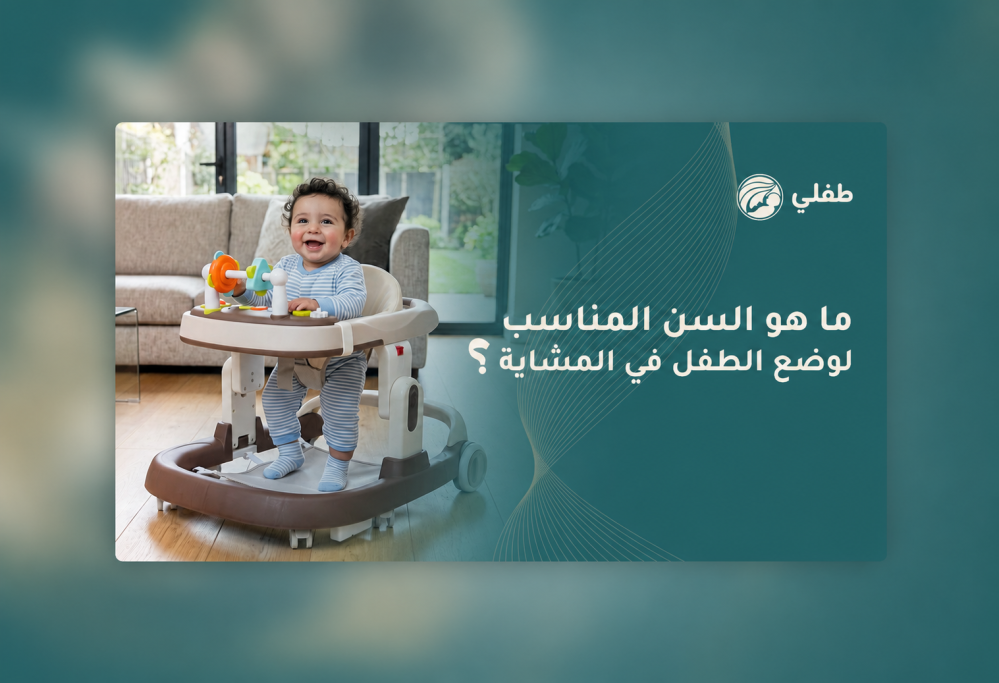
The suitable age to place a baby in a walker differs from one child to another. However, it is not linked to age alone as much as it depends on the completion of certain motor skills, such as the ability to hold the head steady, sit with support, and bear part of the body weight.
Although some parents believe that it helps babies walk earlier, recent research indicates that using a walker does not speed up learning to walk. It may also be associated with some risks if used at an unsuitable time or without following safety guidelines.
Therefore, choosing the right timing and using it safely remain the key factors for protecting the child’s natural development.
Does the Type of Walker Affect the Child’s Walking?
The development of walking skills does not depend on the type of walker alone. It is more closely related to the child’s motor readiness, the suitable age to place the baby in a walker, and using it safely. This can be explained through the following:
Proper Body Support
Choosing a baby walker that provides a comfortable seat with good back support helps the child sit steadily during use. However, this does not replace the importance of spending enough time crawling and moving freely on the floor.
Movement Stability
The more stable the walker is, and the less it rushes during movement, the lower the chance of losing balance. Therefore, it is preferable to choose a model that moves smoothly without excessive speed, especially inside the home. Good movement control also helps give the child a greater sense of safety while moving and exploring the surroundings.
Wheels and Design Quality
The importance of wheels is not limited to ease of movement. They also help control the direction of the walker and reduce shaking when moving across level surfaces, giving the child a greater feeling of stability.
Walker Size
It is necessary for the walker height to suit the child’s height so that the feet touch the floor naturally. If it is too high or too low, it may affect the body position during movement.
It is preferable to choose a walker with height adjustment so it remains suitable as the child grows and their height changes during the period of use.
The Child’s Growth Stage
Even a high-quality walker will not be suitable if it is used before the child gains the ability to control their body and bear part of their weight. Therefore, it should be chosen according to the child’s motor development, not age alone.
Safe Use
Continuous supervision by one of the parents and committing to short usage periods remain among the most important factors that reduce walker risks, regardless of its features or specifications.
In addition, it is recommended to use it in a space free from obstacles, stairs, and unstable furniture, and to stop using it immediately if any problem appears in its stability or movement.
Therefore, choosing a suitable walker in terms of design, stability, and size, while using it at the right time and under continuous supervision, helps provide a safer experience for the child.
Does Using a Walker Depend on Age Only?
Some parents believe that once a child reaches a certain number of months, they become ready to use a walker. However, this belief is not always accurate.
Children’s motor development may differ noticeably even when they are the same age. Some children gain sitting and balance skills early, while others need more time for their muscles to become stronger and more capable of handling movement.
Therefore, pediatricians recommend looking at the level of motor development before considering any tool that helps the child move, because forcing the child to use tools that do not suit their stage may not provide the expected benefit.
What Is the Suitable Age to Place a Baby in a Walker?
Recommendations differ between manufacturers. Some begin from around 6 months, with the minimum age varying according to the walker’s design. The recommended age may extend up to 15 or 16 months depending on the walker’s design and the child’s weight.
However, medical recommendations confirm that the decision should not depend only on the number written on the package, but on the presence of a set of basic skills in the child.
How Does a Child’s Readiness for Movement Develop During the First Year?
Not all children acquire motor skills at the same speed. Therefore, following their development month by month helps parents form a clearer idea of the stage the child is going through, as follows:
From Birth to 5 Months
During the first months, the child focuses on strengthening the neck and back muscles. They also gradually begin to control head movement and move the arms and legs better.
At this stage, the child needs enough supervised tummy time, because this position helps build the muscles they will later depend on for sitting and crawling. Therefore, thinking about a walker is not suitable during this period.
From 6 to 8 Months
Many children begin sitting for longer periods, and some may try to move by crawling or rolling to reach nearby toys.
However, the ability to sit alone does not necessarily mean that the child is ready to use a walker. It is important to make sure that they can maintain balance without clearly leaning their body.
At this stage, the child also begins using their hands to explore objects around them, which reflects the development of coordination between movement and awareness.
From 8 to 10 Months
This is one of the most active periods for many children. The child may begin crawling faster and try to stand while holding onto the sofa or table. They may also move between sitting and standing positions with simple assistance.
Child development specialists see these skills as an important part of the process of learning to walk. Therefore, it is better to encourage the child to practice them inside a safe space instead of relying on tools that limit natural movement.
From 10 to 12 Months
Some children begin taking their first steps while holding onto furniture, while others may be able to walk short distances without help. During this stage, the child’s ability to maintain balance develops noticeably, so practicing natural movement becomes more important than relying on any external tool.
What Signs Show That the Child Has Become More Ready for Movement?
Instead of focusing only on the suitable age to place the baby in a walker, several signs can be observed that indicate the development of the child’s motor skills, such as:
Sitting for a Suitable Period
When the child can sit without losing balance quickly, this reflects improvement in the strength of the trunk and back muscles. The child also becomes able to turn around, hold toys, and move the body without falling easily.
Head and Neck Stability
Full head control is one of the basic skills that comes before many stages of motor development. If the child still needs continuous support to maintain head position, it is better to wait until this part of development is complete.
This helps the child maintain a more stable body position while sitting and reflects suitable development in the strength of the neck and upper body muscles for their age.
Bearing Weight on the Feet
This can be noticed when holding the child in a standing position, as they try to rest on their feet automatically. The child does not have to stand for a long time, but it is important that they show a good ability to bear part of their body weight without clear discomfort.
Desire to Stand
Many children try to hold onto furniture or the edge of the sofa to stand for a few seconds. This behavior is a sign of developing muscle strength and balance. It also reflects the child’s desire to discover new ways of moving.
Moving Freely Around the Space
The child begins crawling quickly or moving between the toys around them, which is a positive sign of natural motor development.
For this reason, experts recommend not rushing this stage, because it helps the child build balance and muscular coordination gradually.
When Is It Better to Delay Using a Walker?
There are cases where waiting is more suitable than rushing to use a walker, even if the child is close to the age recommended by the manufacturer. The most important cases include:
Inability to sit steadily.
Weak head or neck control.
Clear delay in acquiring basic motor skills.
The child having some muscle or joint disorders that require medical follow-up.
If the pediatrician or physical therapist recommends relying on other tools that suit the child’s condition.
As for babies born before their due date, they may need more time to acquire some motor skills. Therefore, it is not recommended to rely on age in months alone when evaluating their readiness to use a walker. It is better for this to be done according to a pediatrician’s assessment.
How Do You Choose a Suitable Walker for Your Child?
When thinking about using a walker after making sure the child is ready, it is better to pay attention to several specifications beyond the suitable age to place the baby in a walker. These specifications help provide a greater level of comfort and safety, including:
A wide base that increases walker stability during movement.
Height adjustment to suit the child’s height.
A padded seat that supports comfortable sitting.
Wheels that move smoothly without rushing forward.
Strong and easy-to-clean materials.
Anti-slip features when approaching edges, if available in the design.
It is also useful to review the maximum weight and height recommended by the manufacturer, because exceeding these limits may affect the efficiency and safety of use.
What Is the Best Baby Walker from My Baby?
If you are looking for the best baby walker from My Baby, you will find a variety of options that combine practical design, safety features, and comfort to suit your child’s needs during different growth stages.
While shopping, you can also explore the best baby bath products available on the website to provide everything your child needs from daily care essentials in one place and with trusted quality. Here are the most notable types of these walkers:
Multi-Feature Walker
This walker is designed to provide the child with a safe space to enjoy movement and play, with a design that considers comfort during daily use and combines practical aspects with entertainment elements that attract the child’s attention. Its main specifications include:
Practical wheels that help provide smooth movement inside the home while maintaining a good level of stability.
A front play panel with bright colors and interactive activities that encourage the child to explore.
Height adjustment to suit the child’s height as they progress through growth stages.
A padded seat that provides comfortable sitting and supports the child while moving.
A dedicated footrest base that provides additional comfort when the child stops moving.
A foldable design that makes it easy to carry or store the walker without taking up much space.
An elegant grey color with modern details that gives it an attractive appearance.
A balanced frame with wide edges that help increase stability during use.
This walker combines ease of use with practical design, giving your child a more comfortable experience during the exploration stage while paying attention to the safety factors parents look for. Order it now.
Red Multi-Feature Walker
If you want to choose a walker with a practical shape and features that suit your child’s daily needs, this model offers a set of advantages that combine comfort and ease of use. The most important include:
A low design that helps the child sit and move with greater stability.
Flexible wheels that make movement smooth on suitable floors inside the home.
A colorful front play panel that adds a fun atmosphere and encourages the child to interact.
A padded seat that provides good back support with comfortable sitting space.
The walker can be folded easily to save space during storage or movement.
A wide base that helps improve balance during use.
Durable materials that withstand repeated daily use.
A design that combines red color with attractive details, giving it a distinctive appearance.
An open space that gives the child more freedom during movement while making it easy for parents to watch them.
This walker is a suitable option for families looking for a product that combines practicality and comfort with a modern design that suits the child’s needs during the early years. Order it now.
Pink Multi-Feature Walker
This walker provides a comfortable experience that combines safety features with an elegant look to help the child enjoy movement and play inside the home, along with a design that meets their needs during the early exploration stage. Its main features include:
A wide frame that provides better stability during movement.
Practical wheels that help provide smooth movement inside the home.
A padded seat that provides suitable comfort during usage periods.
A front play panel that adds an entertaining side and encourages the child to interact.
Height adjustment to suit the child’s growth.
Front edges designed to help reduce the effect of bumps during movement.
Strong materials suitable for daily use over long periods.
A foldable design that makes it easy to store the walker when not needed.
A soft pink color with elegant details that gives it an attractive appearance.
Comfortable sitting space that gives the child freedom of movement without feeling restricted.
This walker combines quality and ease of use in one design, making it a practical option that helps the child enjoy the first stage of movement while providing a suitable level of comfort and stability. Order it now.
Why Does Natural Movement Remain More Important?
Some people think that a walker helps the child learn to walk quickly, but studies have not proven that it speeds up acquiring this skill. In contrast, the child needs enough time for crawling, sitting, standing, and moving between different positions.
These activities strengthen the muscles, improve the sense of balance, and develop coordination between the brain and body. Therefore, many specialists recommend providing a safe home environment that allows the child to move freely under parental supervision, because it represents the natural foundation for developing motor skills during the first year of life.
What Are the Common Mistakes That May Reduce the Safety of Walker Use?
Walker safety is not related only to manufacturing quality. It also does not depend only on the suitable age to place the baby in a walker, but on how it is used and the environment around the child. In many cases, injuries happen due to practices that can be easily avoided if parents are aware of them. The most common mistakes include:
Leaving the Child Inside the Walker for Long Periods
Some children get used to sitting in the walker for continuous periods because it gives them a form of entertainment. However, this reduces the time they spend crawling, sitting, and standing freely.
If a walker is chosen, it is better to use it for short periods while providing enough space for the child to move naturally, because these activities play a bigger role in developing muscle strength and balance.
Using It Near Dangerous Places
Even inside the home, there may be places that are not suitable for walker movement, such as stairs, kitchens during cooking, balconies, narrow hallways, and uneven floors. For this reason, it is recommended to dedicate a safe space free from obstacles if the family decides to use it.
Adjusting the Height Incorrectly
When the walker height is too high or too low, the child may stand in an uncomfortable position, which affects how the feet touch the floor.
Therefore, it should be adjusted so that the feet touch the floor comfortably without standing on the tips of the toes continuously or bending the knees excessively.
Believing That It Speeds Up Learning to Walk
One of the most common beliefs is that a walker makes a child walk earlier, but scientific research has not proven a clear benefit in this regard. Walking development depends on the development of the nervous system, muscles, and balance, which are skills the child develops gradually during free movement.
What Are the Most Important Tips for Using a Walker More Safely?
If parents choose to use a walker after making sure it is suitable for the child’s condition, it is better to follow a set of guidelines that reduce the possibility of accidents, including:
Use the walker only on a level floor.
Keep the child under supervision throughout the usage period.
Keep electrical cords and hot appliances away from the child’s reach.
Close stair entrances using child safety gates.
Check the condition of the wheels regularly to make sure they are safe.
Do not allow the child to use the walker if any damage or breakage appears on it.
Stop using it when the child approaches the maximum height or weight limit set by the manufacturer.
It is also better to remove small tables or items that may tip over from the area, because the child may be able to reach them more easily while moving.
Are There Alternatives to Walkers That Support Child Development?
Yes, many pediatricians prefer relying on activities that encourage natural movement instead of using a walker, because they help the child develop balance and muscular coordination gradually. Some useful options include:
Floor play sessions inside a safe space.
Encouraging the child to crawl to reach toys.
Allowing the child to try standing while holding onto stable furniture.
Using push toys designed for children after they begin standing and walking with assistance.
These activities help the child acquire movement skills at their natural pace without relying on tools that may limit some basic movement patterns.
Frequently Asked Questions
Can the Right Time to Use a Walker Differ from One Child to Another?
Yes, the rate of motor development is not the same for all children. One child may acquire sitting and standing skills weeks or months before another. Therefore, it is better to evaluate the child’s motor abilities instead of comparing their age with other children.
Can a Child Become More Dependent on the Walker If Used Daily?
Yes, some children may get used to spending a long time inside the walker if it is used frequently. Therefore, it is better that it does not replace free play or crawling, because a variety of movement activities contributes more to the development of natural skills.
In addition, giving the child the opportunity to move on the floor helps them gain balance and strengthen their muscles gradually in a way that suits their growth stages.
How Do I Know That the Walker Height Is Suitable for My Child?
The height is suitable when the child’s feet touch the floor comfortably with a slight bend in the knees, without needing to stand on the tips of the toes or sit in a low position that limits movement.
Does the Child Need to Wear Shoes Inside the Walker?
No, shoes are not necessary inside the home in most cases if the floor is clean and safe. Foot contact with the floor helps improve the child’s sense of balance and movement.
Can a Walker Affect the Child’s Desire to Crawl?
Yes, the child may spend less time crawling if they rely on the walker for long periods. Crawling is an important stage for strengthening the muscles and improving coordination between the arms and legs before walking.
Therefore, it is recommended to give the child daily time for movement and play on the floor inside a safe environment so they can acquire these skills naturally and gradually.
Can a Walker Be Used After the Child Starts Walking?
No, when the child becomes able to walk independently, the need for a walker decreases, because natural movement gives them a better opportunity to develop balance and control their steps.
Are All Walkers Available in the Market Similar?
No, they may differ in terms of stability level, height adjustment, material quality, and built-in safety features. Therefore, it is better to review the technical specifications and choose a product that suits the child’s age and weight while following the usage instructions.